|
If you are thinking about suicide... read
this first!
 If you
are feeling suicidal now, please stop long enough to read this. It will
only take about five minutes. I do not want to talk you out of your bad
feelings. I am not a therapist or other mental health professional - only
someone who knows what it is like to be in pain. If you
are feeling suicidal now, please stop long enough to read this. It will
only take about five minutes. I do not want to talk you out of your bad
feelings. I am not a therapist or other mental health professional - only
someone who knows what it is like to be in pain.
I don’t know who you are, or why you are reading this page. I only
know that for the moment, you’re reading it, and that is good. I can
assume that you are here because you are troubled and considering ending
your life. If it were possible, I would prefer to be there with you at
this moment, to sit with you and talk, face to face and heart to heart.
But since that is not possible, we will have to make do with this.
I have known a lot of people who have wanted to kill themselves, so I
have some small idea of what you might be feeling. I know that you might
not be up to reading a long book, so I am going to keep this short. While
we are together here for the next five minutes, I have five simple,
practical things I would like to share with you. I won’t argue with you
about whether you should kill yourself. But I assume that if you are
thinking about it, you feel pretty bad.
Well, you’re still reading, and that’s very good. I’d like to ask
you to stay with me for the rest of this page. I hope it means that
you’re at least a tiny bit unsure, somewhere deep inside, about whether
or not you really will end your life. Often people feel that, even in the
deepest darkness of despair. Being unsure about dying is okay and normal.
The fact that you are still alive at this minute means you are still a
little bit unsure. It means that even while you want to die, at the same
time some part of you still wants to live. So let’s hang on to that, and
keep going for a few more minutes.
Start by considering this statement:
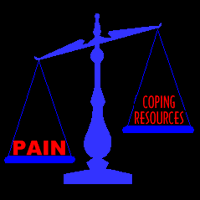
“Suicide is not
chosen; it happens
when pain exceeds
resources for coping with pain.”
That’s all it’s about. You are not a bad person, or crazy, or weak,
or flawed, because you feel suicidal. It doesn’t even mean that you
really want to die - it only means that you have more pain than you can
cope with right now. If I start piling weights on your shoulders, you will
eventually collapse if I add enough weights... no matter how much you want
to remain standing. Willpower has nothing to do with it. Of course you
would cheer yourself up, if you could.
 Don’t accept
it if someone tells you, “that’s not enough to be suicidal
about.” There are many kinds of pain that may lead to suicide.
Whether or not the pain is bearable may differ from person to person. What
might be bearable to someone else, may not be bearable to you. The point
at which the pain becomes unbearable depends on what kinds of coping
resources you have. Individuals vary greatly in their capacity to
withstand pain. Don’t accept
it if someone tells you, “that’s not enough to be suicidal
about.” There are many kinds of pain that may lead to suicide.
Whether or not the pain is bearable may differ from person to person. What
might be bearable to someone else, may not be bearable to you. The point
at which the pain becomes unbearable depends on what kinds of coping
resources you have. Individuals vary greatly in their capacity to
withstand pain.
When pain exceeds pain-coping resources, suicidal feelings are the
result. Suicide is neither wrong nor right; it is not a defect of
character; it is morally neutral. It is simply an imbalance of pain versus
coping resources.
You can survive suicidal feelings if you do either of two things: (1)
find a way to reduce your pain, or (2) find a
way to increase your coping resources. Both are possible.
Now I want to tell you five things to think about.
1) You
need to hear that people do get through this -- even people who feel as
badly as you are feeling now. Statistically, there is a very good chance
that you are going to live. I hope that this information gives you some
sense of hope.
2) Give
yourself some distance. Say to yourself, “I will wait 24 hours
before I do anything.” Or a week. Remember that feelings and
actions are two different things - just because you feel like killing
yourself, doesn’t mean that you have to actually do it right this
minute. Put some distance between your suicidal feelings and suicidal
action. Even if it’s just 24 hours. You have already done it for 5
minutes, just by reading this page. You can do it for another 5 minutes
by continuing to read this page. Keep going, and realize that while you
still feel suicidal, you are not, at this moment, acting on it. That is
very encouraging to me, and I hope it is to you.
3) People
often turn to suicide because they are seeking relief from pain.
Remember that relief is a feeling. And you have to be alive to feel it.
You will not feel the relief you so desperately seek, if you are dead.
4) Some people will
react badly to your suicidal feelings, either because they are
frightened, or angry; they may actually increase your pain instead of
helping you, despite their intentions, by saying or doing thoughtless
things. You have to understand that their bad reactions are about their
fears, not about you.
But there are people out there who can be with you in this horrible
time, and will not judge you, or argue with you, or send you to a
hospital, or try to talk you out of how badly you feel. They will simply
care for you. Find one of them. Now. Use your 24 hours, or your week,
and tell someone what’s going on with you. It is okay to ask for help.
Try:
- Send an anonymous e-mail to The
Samaritans
- Call 1-800-SUICIDE in the U.S.
- Call Kids
Helpline in Australia 1800 55 1800
- Reach
Out www.reachout.com.au
- Teenagers, call Covenant House NineLine, 1-800-999-9999
- Look in the front of your phone book for a crisis line
- Call a psychotherapist
- Carefully choose a friend or a minister or rabbi, someone who is
likely to listen.
But don’t give yourself the additional burden of trying to deal with
this alone. Just talking about how you got to where you are, releases
an awful lot of the pressure, and it might be just the additional
coping resource you need to regain your balance.
5) Suicidal feelings are,
in and of themselves, traumatic. After they subside, you need to
continue caring for yourself. Therapy is a really good idea. So are
the various self-help groups available both in your community and on
the Internet.
Well, it’s been a few minutes and you’re
still with me. I’m really glad.
Since you have made it this far, you deserve a reward. I think you
should reward yourself by giving yourself a gift. The gift you will give
yourself is a coping resource. Remember, back up near the top of the page,
I said that the idea is to make sure you have more coping resources than
you have pain. So let’s give you another coping resource, or two, or
ten...! until they outnumber your sources of pain.
Now, while this page may have given you some small relief, the best
coping resource we can give you is another human being to talk with. If
you find someone who wants to listen, and tell them how you are feeling
and how you got to this point, you will have increased your coping
resources by one. Hopefully the first person you choose won’t be the
last. There are a lot of people out there who really want to hear from
you. It’s time to start looking around for one of them.
Now: I’d like you to
call someone.
And while you’re at it, you can still stay with me for a bit. Check
out these sources of online help.
Additional things to read at this site:
- How
serious is our condition? ...“he only took 15 pills, he
wasn’t really serious...” if others are making you feel
like you’re just trying to get attention... read this.
- Why
is it so hard for us to recover from being suicidal? ...while
most suicidal people recover and go on, others struggle with suicidal
thoughts and feelings for months or even years. Suicide and
post-traumatic stress disorder (PTSD).
- Recovery
from grief and loss ...has anyone significant in your life
recently died? You would be in good company... many suicidal people
have recently suffered a loss.
- The
stigma of suicide that prevents suicidal people from
recovering: we are not only fighting our own pain, but the pain that
others inflict on us... and that we ourselves add to. Stigma is a huge
complicating factor in suicidal feelings.
- Resources
about depression ...if you are suicidal, you are most likely
experiencing some form of depression. This is good news, because
depression can be treated, helping you feel better.
Do you know someone who is suicidal... or would you like to be able to
help, if the situation arises? Learn what to do, so that you can make the
situation better, not worse.
Other online sources of help:
- The
Samaritans - trained volunteers are available 24 hours a day to
listen and provide emotional support. You can call a volunteer on the
phone, or e-mail them. Confidential and non-judgmental. Short of
writing to a psychotherapist, the best source of online help.
- Talk to a
therapist online - this is a list of over 200 psychotherapists and
other professionally trained counselors who will interact with you via
the Internet. Some can respond within 24-36 hours. Most charge a small
fee but can be worth it. Be sure to read the background information.
- Reach
Out - www.reachout.com.au
- Depression support group online: Walkers
in Darkness - Please note: this is a very big group, but amidst
all the chatter (and occasional bickering), it is possible to find
someone who will hear you and offer support.
- Newsgroup: alt.support.depression
is a good source of peer support.
- Psych Central
has a good listing of online resources for suicide - and other mental
health challenges.
- Still feel bad? These jokes
might relieve the pressure for a minute or two.
- If you want help finding a human being to talk with in person, who
can help you live through this, try reading this article about how to Choose
a Competent Counselor.
Sometimes people need additional private help before they are ready to
talk with someone in person. Here are three books you could read on your
own in private. I know from personal experience that each one has helped
someone like you.
Reprinted with permission. Suicide: Read This First (http://www.metanoia.org/suicide)
was written by Martha Ainsworth based on work by David Conroy, Ph.D. To
talk with a caring listener about your suicidal feelings, in the U.S. call
1-800-SUICIDE any time, day or night. Online, send an anonymous e-mail to
jo@samaritans.org for confidential and non-judgmental help, or visit http://www.befrienders.org
|
 ..........Thinking
Of Sucide - Read Me First !?..........
..........Thinking
Of Sucide - Read Me First !?..........